Pull the syringe to:
(0.100ml)
Concentration: 5.00 mg/ml
Doses per vial: 30
This calculator is provided as a reference tool for research purposes only. Always follow your institution’s safety protocols when handling research compounds.
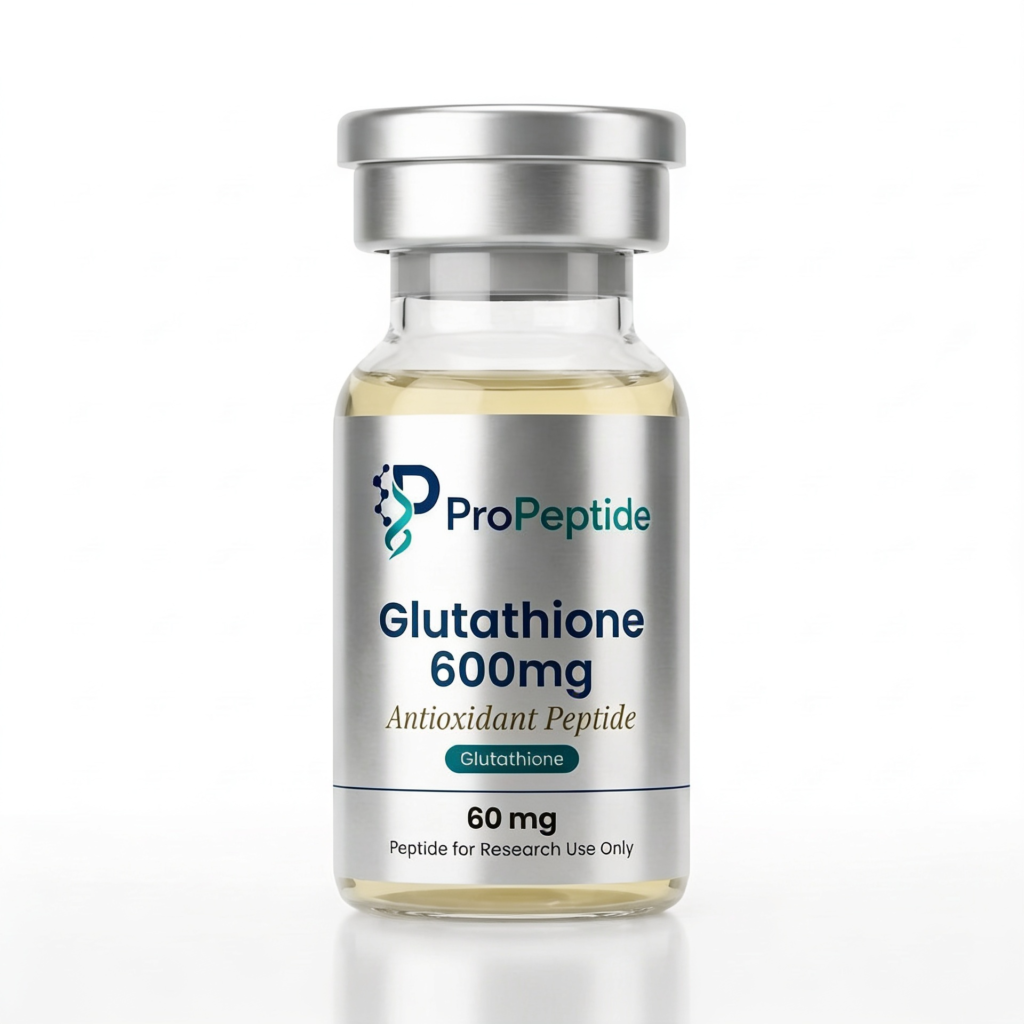
Glutathione 600mg is a tripeptide research compound studied in relation to cellular redox biology, thiol chemistry, oxidative stress pathway models, mitochondrial glutathione research, detoxification enzyme systems and antioxidant pathway research.
Glutathione is commonly abbreviated as GSH when referring to its reduced form. PubChem describes glutathione as a tripeptide consisting of glutamic acid, cysteine and glycine, with the molecular formula C10H17N3O6S and molecular weight of approximately 307.33 g/mol.
This product is supplied for laboratory research use only. It is not a medicine, supplement, detox product, skin-lightening product, antioxidant treatment, anti-ageing product, wellness product or injectable product for human use.
| Product Detail | Information |
|---|---|
| Product name | Glutathione |
| Common research names | GSH, reduced glutathione, L-glutathione |
| Size | 600mg |
| Product type | Tripeptide research compound |
| Research category | Redox Research / Oxidative Stress Research / Cellular Metabolism Research |
| Common research interest | GSH/GSSG redox balance, thiol biology, oxidative stress, mitochondrial glutathione and detoxification pathway models |
| Peptide type | Tripeptide |
| Main amino acid components | Glutamic acid, cysteine and glycine |
| Molecular formula | C10H17N3O6S |
| Molecular weight | Approximately 307.33 g/mol |
| Form | Powder or supplier-specific research preparation |
| Intended use | Laboratory research only |
| Human use | Not for human consumption, administration, skin lightening, detox, wellness use or injection |
| Documentation | Certificate of Analysis should be checked before use |
| Component | Research Class | General Research Role |
| Glutamic acid | Amino acid component | Part of the glutathione tripeptide structure |
| Cysteine | Sulfur-containing amino acid component | Provides the thiol group central to GSH redox chemistry |
| Glycine | Amino acid component | Part of the glutathione tripeptide structure |
| Reduced glutathione, GSH | Cellular thiol research compound | Studied in redox balance, antioxidant enzyme systems and oxidative stress models |
| Oxidised glutathione, GSSG | Oxidised disulfide form | Studied in GSH/GSSG ratio and redox-state research |
| Molecular formula | C10H17N3O6S | Listed by PubChem for glutathione |
| Molecular weight | Approximately 307.33 g/mol | Useful for laboratory concentration and molar calculation planning |
Product identity, reduced or oxidised form, purity, salt form, assay result and batch information should always be confirmed through supplier documentation and the Certificate of Analysis.
Glutathione is studied as a central cellular redox compound. In research models, reduced glutathione, known as GSH, can be converted to oxidised glutathione, known as GSSG, during redox reactions. The GSH/GSSG balance is commonly examined as part of cellular redox-state research.
Research literature describes the reduced-to-disulfide glutathione redox couple, GSH, as a key indicator of the cellular redox environment. Glutathione is also studied in mitochondrial research, including mitochondrial redox homeostasis, oxidative stress, programmed cell death and GSH/GSSG-related pathway models.
This should be understood as laboratory and research literature context only. It should not be used as a claim that a research-use Glutathione 600mg product is approved, safe or effective for detox, skin lightening, anti-ageing, wellness, fatigue, liver support, immune support or human treatment.
| Research Area | Glutathione |
| Main research category | Redox and oxidative stress research |
| Common abbreviation | GSH |
| Oxidised form | GSSG |
| Structure | Tripeptide made from glutamic acid, cysteine and glycine |
| Key chemical feature | Thiol group |
| Common pathway interest | GSH/GSSG balance, oxidative stress, mitochondrial redox and detoxification enzyme models |
| Enzyme system interest | Glutathione peroxidase, glutathione reductase and glutathione S-transferase pathway research |
| Evidence limitation | Research context does not make bulk glutathione products approved for human use |
| Product limitation | Research use only, not approved for human use |
| Feature | Glutathione | NAD+ |
| Research class | Tripeptide redox compound | Nucleotide coenzyme research compound |
| Common abbreviation | GSH | NAD+ |
| Main research interest | Thiol redox balance and oxidative stress pathways | Redox metabolism, sirtuin pathway research and cellular energy models |
| Oxidised/reduced pair | GSH/GSSG | NAD+/NADH |
| Common overlap | Cellular metabolism and oxidative stress research | Cellular metabolism and mitochondrial research |
| Human-use claim | Not appropriate for research-use products | Not appropriate for research-use products |
| Feature | Glutathione | GHK-Cu |
| Research class | Tripeptide redox compound | Copper peptide complex |
| Main components | Glutamic acid, cysteine and glycine | GHK tripeptide complexed with copper |
| Common research focus | Redox balance, oxidative stress and detoxification pathway research | Copper biology, extracellular matrix and skin pathway research |
| Key chemical feature | Thiol group | Copper coordination |
| Common SEO risk | Detox, antioxidant treatment and skin-lightening claims | Skincare, anti-ageing and hair-growth claims |
| Safer positioning | GSH redox research compound | Copper peptide research compound |
| Feature | Glutathione | NAC |
| Research class | Tripeptide | Cysteine derivative |
| Main pathway connection | Direct GSH/GSSG redox system research | Cysteine availability and glutathione precursor pathway research |
| Common research interest | Cellular redox, thiol biology and oxidative stress models | Thiol chemistry, cysteine metabolism and oxidative stress research |
| Human-use claim | Not appropriate for this research-use product | Depends on regulated product context, not research-use material |
| Strength | Product Page Positioning |
| Glutathione 500mg | Lower research amount for smaller protocol-specific concentration planning |
| Glutathione 600mg | Mid-strength research amount for redox, oxidative stress and GSH pathway studies |
| Glutathione 1000mg | Larger research amount for protocol-specific redox pathway work |
| Glutathione 1500mg | Higher research amount requiring clear concentration planning and handling notes |
Glutathione strengths should be treated as product variants, not separate therapeutic claims. If multiple strengths are listed separately, each page should have a strength-specific title, meta description, slug, concentration table and internal links to reduce SEO cannibalisation.
| Common Online Claim | Safer Research-Use Wording |
| Detox | Studied in glutathione-dependent detoxification enzyme pathway research |
| Skin whitening or brightening | Not an approved or appropriate product claim |
| Antioxidant treatment | Better framed as oxidative stress and redox pathway research |
| Anti-ageing | Not an approved or appropriate product claim |
| Liver support | Better framed as hepatic redox and detoxification pathway research models |
| Immune support | Better framed as cellular stress and redox biology research |
| Energy support | Not an approved or appropriate product claim |
| Recovery | Not an approved or appropriate product claim |
| Injectable antioxidant | Not suitable for research-use product positioning |
Glutathione 600mg is not intended to diagnose, treat, cure or prevent any disease. It is not supplied for detox, liver support, skin lightening, skin brightening, anti-ageing, antioxidant therapy, immune support, fatigue, recovery, wellness, cosmetic use, supplementation, injection, infusion or therapeutic use.
All information on this page is provided for laboratory research and product handling context only.
There is no universal recommended dilution for Glutathione 600mg. Dilution depends on the research protocol, required working concentration, assay design, solvent compatibility, reduced or oxidised form, pH conditions, storage method and validated laboratory procedure.
Because 600mg is a larger compound amount than standard small peptide vials, concentration planning must also consider solubility, viscosity, assay compatibility and laboratory handling limits. Mathematical concentration examples do not mean every concentration is practical or compatible.
For research concentration planning only, the basic formula is:
Total compound amount divided by diluent or solvent volume equals final concentration.
| Diluent or Solvent Added to 600mg Amount | Final Concentration |
| 1mL | 600mg/mL |
| 2mL | 300mg/mL |
| 5mL | 120mg/mL |
| 6mL | 100mg/mL |
| 10mL | 60mg/mL |
| 20mL | 30mg/mL |
| 50mL | 12mg/mL |
| 60mL | 10mg/mL |
| 100mL | 6mg/mL |
| 600mL | 1mg/mL |
These are mathematical research concentration examples only. They are not solubility recommendations, human dosing instructions, injection instructions, infusion instructions or supplementation directions.
Before handling Glutathione 600mg in a laboratory setting, make sure all materials, documentation and clean handling conditions are prepared.
| Item | Purpose |
| Product container | Contains Glutathione research compound |
| Certificate of Analysis | Confirms batch-level testing information |
| SDS or safety documentation | Provides handling, hazard and disposal guidance |
| Suitable research-grade diluent or solvent | Used to prepare a working research solution if compatible |
| pH and assay compatibility notes | Helps protect research validity |
| Sterile or clean lab consumables | Helps reduce contamination and cross-contamination risk |
| Personal protective equipment | Gloves, lab coat and eye protection |
| Approved disinfectant | Used for bench and handling area preparation |
| Laboratory labels | Records concentration, date, batch and handler details |
| Controlled storage access | Supports correct storage after preparation |
| Chemical or laboratory waste container | Used for compliant waste disposal |
The following is a general laboratory handling framework only. Always follow the product Certificate of Analysis, supplier documentation, SDS, institutional procedures and validated research protocol.
Check the product label, batch number, Certificate of Analysis, SDS, form of glutathione and storage requirements before handling the product.
Use a clean laboratory workspace suitable for handling research compounds. Wear appropriate PPE and disinfect the bench surface and required equipment.
Do not assume every peptide diluent or solvent is suitable. Confirm compatibility through supplier documentation, SDS and the approved research protocol.
Add the selected research-grade diluent or solvent according to laboratory procedure. Avoid uncontrolled splashing, aerosol generation or unnecessary exposure.
Gently mix according to the validated protocol until the compound is dissolved or prepared as required. Do not heat, sonicate, vortex or adjust pH unless the protocol specifically allows it.
Check the preparation for visible particles, cloudiness, precipitation, unusual colour changes or separation. If anything appears abnormal, quarantine the preparation and check supplier documentation.
Label the vial, bottle or aliquots with the product name, concentration, diluent or solvent used, date prepared, batch number and researcher initials.
Place the prepared solution into the required storage condition as soon as possible. Avoid unnecessary temperature cycling, light exposure or repeated freeze-thaw cycles.
Some research compounds may not dissolve easily at higher concentrations. Solubility should always be handled according to validated laboratory protocol.
| Issue | What It May Indicate | Safer Response |
| Powder remains after mixing | Concentration may be too high or diluent may not be suitable | Check CoA, SDS and protocol |
| Cloudiness appears | Incomplete dissolution or incompatibility | Stop and review preparation method |
| Precipitation occurs | Solubility, pH or concentration issue | Reassess working concentration and solvent |
| Colour change | Possible degradation, oxidation or contamination | Do not continue without supplier guidance |
| Separation occurs | Vehicle or preparation incompatibility | Quarantine and review documentation |
| Product form unclear | GSH, GSSG or salt-form confusion | Stop and confirm CoA before using |
| Storage Factor | Guidance |
| Product form | Dry research compound or supplier-specific preparation |
| Storage condition | Follow supplier label, CoA and SDS |
| Light exposure | Protect from unnecessary light exposure |
| Moisture exposure | Keep sealed until use |
| Oxidation control | Minimise unnecessary exposure where relevant |
| Temperature changes | Avoid repeated temperature cycling |
| Handling | Minimise unnecessary opening and exposure |
| Storage Factor | Guidance |
| Storage condition | Follow validated research protocol |
| Labelling | Record concentration, diluent or solvent, date and batch number |
| Redox form tracking | Record whether the preparation is intended for GSH or GSSG-related research |
| Freeze-thaw cycles | Avoid repeated freeze-thaw exposure where relevant |
| Aliquoting | Use small research aliquots where appropriate |
| Light exposure | Protect from unnecessary light exposure if required |
| Contamination control | Use clean laboratory technique |
| Disposal | Dispose according to laboratory waste procedures |
Glutathione preparations may be sensitive to temperature, light, pH, oxidation, solvent conditions and contamination. Storage conditions should be confirmed through supplier documentation or the laboratory’s validated method.
This page does not provide human dosing, injection instructions, infusion instructions, IV preparation instructions, supplementation instructions or administration guidance.
Glutathione 600mg is not supplied for human or animal administration. It is a laboratory research-use product only.
For research settings, any measured aliquots should be prepared according to the concentration required by the approved research protocol. All calculations should be checked, documented and traceable.
| Planning Item | What to Record |
| Final concentration | Total glutathione amount and diluent or solvent volume |
| Working solution | Concentration used in the research protocol |
| Aliquot volume | Volume transferred into each labelled lab container |
| Batch details | Product batch, CoA and preparation date |
| Glutathione form | Reduced, oxidised or supplier-specific form |
| Solvent or diluent | Exact solvent, percentage and preparation method |
| pH or buffer details | Buffer system or pH conditions if relevant |
| Storage location | Fridge, freezer, desiccator or other controlled storage area |
| Handler details | Researcher name or initials |
| Preparation date | Date and time of preparation |
| Disposal date | When the aliquot should no longer be used |
| Strength check | Confirmation that the 600mg amount matches the approved research protocol |
Correct handling is important for research consistency, contamination control, redox stability and product traceability. Most mistakes occur when products are not labelled clearly, solvent compatibility is assumed, concentration calculations are not recorded or storage conditions are not followed.
Because glutathione is commonly promoted online in relation to detox, skin lightening, antioxidant therapy and wellness injections, product pages should avoid wording that could be interpreted as encouraging human self-use, injection, infusion, cosmetic use, therapeutic use or supplementation.
| Always | Why It Matters |
| Check the Certificate of Analysis | Confirms batch-level information |
| Review the SDS | Supports safe chemical handling and disposal |
| Confirm the glutathione form | Helps avoid confusing reduced and oxidised forms |
| Confirm solvent compatibility | Prevents failed preparation or invalid research results |
| Use PPE | Reduces exposure and contamination risk |
| Label every container and aliquot | Prevents mix-ups |
| Record concentration calculations | Supports traceability |
| Record buffer or pH conditions | Important for redox and assay consistency |
| Use clean laboratory technique | Reduces contamination risk |
| Follow institutional protocols | Keeps handling consistent and auditable |
| Store according to documentation | Helps protect compound integrity |
| Dispose of lab waste correctly | Supports safety and compliance |
| Use research-use wording only | Reduces misleading human-use interpretation |
| Never | Why It Is Risky |
| Never use for self-injection or infusion | Product is research use only |
| Never sell or promote as a detox product | Creates human-use and compliance risk |
| Never make skin-lightening or skin-brightening claims | Not an approved or appropriate product claim |
| Never promote as an antioxidant treatment | Not suitable for a research-use product page |
| Never market as liver support or immune support | Not an approved or appropriate product claim |
| Never make anti-ageing or wellness claims | Creates misleading human-use interpretation |
| Never assume reduced and oxidised glutathione are interchangeable | They are different redox forms |
| Never assume solvent compatibility | Preparation depends on protocol and product form |
| Never assume purity without CoA | Batch quality must be documented |
| Never use a damaged or unlabelled container | Identity and integrity may be uncertain |
| Never leave prepared solutions unlabelled | Creates traceability risk |
| Never rely on social media, beauty clinic, detox clinic or wellness injection protocols | They may be inaccurate, unsafe or non-compliant |
The table below is for concentration planning only. It does not represent dosage, injection quantity, infusion quantity, supplementation guidance or cosmetic-use instructions.
| Total Product Amount | Diluent or Solvent Volume | Final Concentration |
| 600mg | 1mL | 600mg/mL |
| 600mg | 2mL | 300mg/mL |
| 600mg | 5mL | 120mg/mL |
| 600mg | 6mL | 100mg/mL |
| 600mg | 10mL | 60mg/mL |
| 600mg | 20mL | 30mg/mL |
| 600mg | 50mL | 12mg/mL |
| 600mg | 60mL | 10mg/mL |
| 600mg | 100mL | 6mg/mL |
| 600mg | 600mL | 1mg/mL |
If a researcher adds 60mL of a suitable validated research diluent to 600mg of glutathione, the resulting concentration is 10mg/mL.
This calculation is for research concentration planning only. It is not a human or animal dosing example, injection example, infusion example or supplementation instruction.
Glutathione is a tripeptide research compound made from glutamic acid, cysteine and glycine. It is commonly studied in relation to cellular redox balance, oxidative stress pathway models, mitochondrial glutathione and detoxification enzyme systems.
Yes. Glutathione is a tripeptide, meaning it is made from three amino acid components. It is usually discussed as a small redox-active peptide compound rather than a larger signalling peptide.
GSH commonly refers to reduced glutathione. It is often studied alongside oxidised glutathione, known as GSSG, to understand cellular redox balance and oxidative stress models.
Glutathione is commonly studied in relation to GSH/GSSG redox balance, oxidative stress, mitochondrial redox homeostasis, glutathione peroxidase, glutathione reductase and glutathione S-transferase pathway research.
This research product is not approved or supplied for detox, skin lightening, skin brightening, anti-ageing, antioxidant treatment, liver support, wellness, supplementation, injection, infusion or human administration. It should be described only as a laboratory research product.
No. Glutathione is a tripeptide redox compound commonly abbreviated as GSH. NAD+ is a separate nucleotide coenzyme research compound involved in redox metabolism and cellular energy research.
No. Glutathione is a tripeptide redox compound, while GHK-Cu is a copper peptide complex. They belong to different research categories.
The compound type is the same, but the total product amount is different. Glutathione 600mg allows different concentration planning and should have its own strength-specific title, meta description, slug and concentration table.
A Certificate of Analysis provides batch-level testing information. It helps researchers verify product identity, purity, form, assay result and quality documentation before use in a research setting.
| Resource | Why It Is Useful |
| PubChem Glutathione compound profile | Useful background on glutathione identity, tripeptide structure, molecular formula and molecular weight. |
| Glutathione and thiol redox network review | Useful background on the GSH redox couple and glutathione-dependent thiol enzyme systems. |
Research Use Only: Glutathione 600mg is supplied strictly for laboratory research purposes. It is not intended for human or animal consumption, injection, infusion, therapeutic use, cosmetic use, diagnostic use, detox, skin lightening, skin brightening, antioxidant treatment, liver support, immune support, supplementation, anti-ageing, wellness, body enhancement or performance enhancement. Information on this page is provided for research education and product handling context only. Always follow applicable laws, institutional procedures, supplier documentation, SDS guidance and qualified laboratory protocols.
Find research peptides, certificate documentation, guides and key product categories in one clean menu.