Pull the syringe to:
(0.100ml)
Concentration: 5.00 mg/ml
Doses per vial: 30
This calculator is provided as a reference tool for research purposes only. Always follow your institution’s safety protocols when handling research compounds.
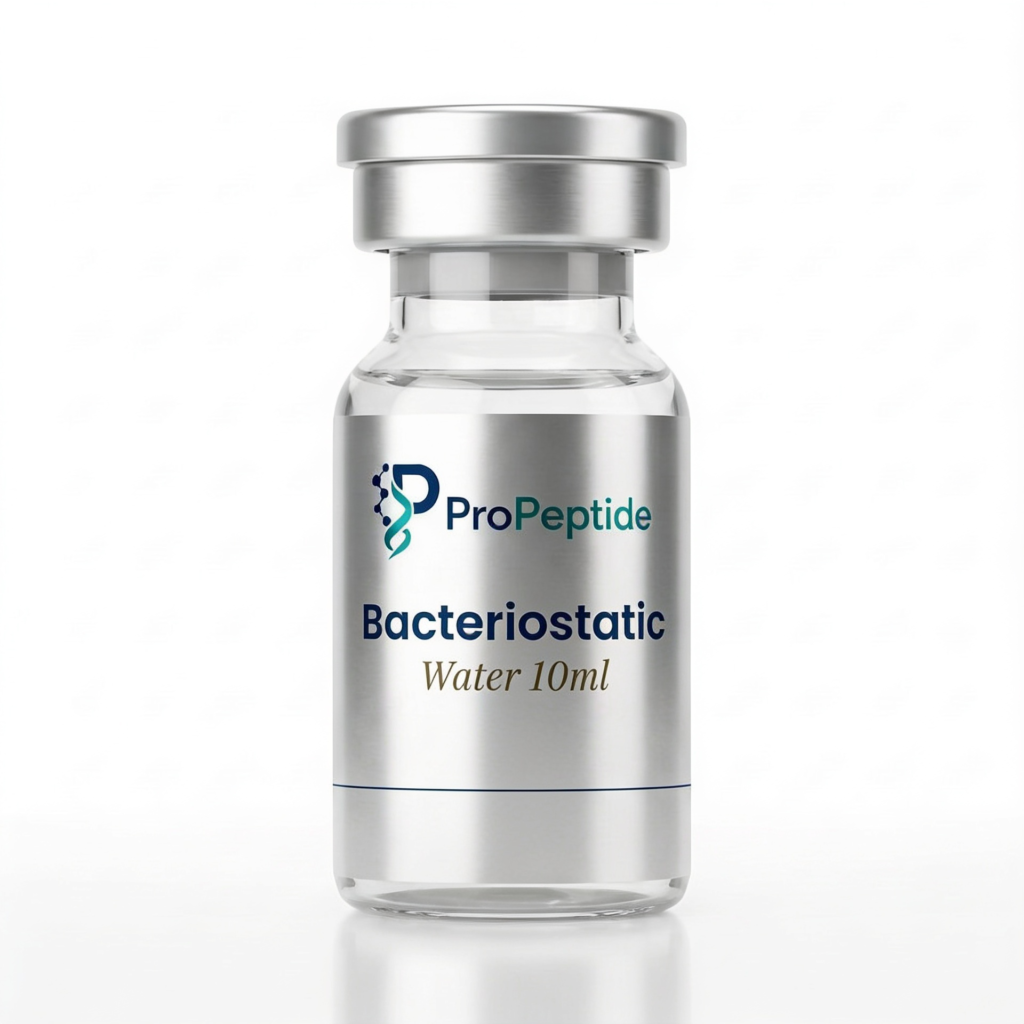
BAC Water 10ml is a laboratory research diluent commonly used in research settings for aqueous preparation, concentration planning and handling of compatible research materials.
“BAC Water” usually refers to bacteriostatic water, which is water containing a bacteriostatic preservative. In regulated USP medicine labelling, bacteriostatic water commonly contains benzyl alcohol as the preservative. However, the exact preservative concentration, sterility status, vial type, intended use and quality standard must always be confirmed through the product label, Certificate of Analysis and supplier documentation.
For this product page, BAC Water 10ml should be positioned only as a laboratory research-use diluent. It should not be written as an injection product, medical water, medicine, sterile medicine, pharmacy product or human-use preparation.
| Product Detail | Information |
|---|---|
| Product name | BAC Water |
| Common name | Bacteriostatic Water |
| Size | 10ml |
| Product type | Research diluent / laboratory preparation aid |
| Research category | Lab Supplies / Reconstitution Support / Concentration Planning |
| Common research use | Laboratory preparation and dilution of compatible research materials |
| Preservative | Must be confirmed by product label and documentation |
| Common preservative context | Benzyl alcohol is commonly used in regulated bacteriostatic water products |
| Form | Liquid |
| Intended use | Laboratory research use only |
| Human use | Not for human or animal injection, infusion, consumption or administration |
| Documentation | Product label, CoA or supplier documentation should be checked before use |
Important: Do not describe this product as “for injection” unless the product is lawfully supplied and labelled for that purpose. A research-use BAC Water product should remain clearly separated from regulated Bacteriostatic Water for Injection products.
| Component | Research Class | General Role |
| Water | Aqueous diluent base | Used as the main liquid vehicle in compatible laboratory preparation |
| Bacteriostatic preservative | Preservative component | Helps limit bacterial growth in the container after opening where validated and documented |
| Benzyl alcohol | Common preservative in regulated bacteriostatic water | Often used at 0.9% or 1.1% in regulated USP bacteriostatic water labelling |
| 10ml vial volume | Product volume | Used for laboratory concentration planning |
| Container closure | Supplier-specific | Must be checked for seal integrity and handling suitability |
| Sterility status | Documentation-dependent | Must be confirmed by label and supplier documentation |
| Expiry and batch details | Batch-specific | Required for traceability and quality checks |
DailyMed describes regulated Bacteriostatic Water for Injection, USP as containing 0.9% or 1.1% benzyl alcohol as a bacteriostatic preservative, depending on the listed product.
BAC Water is used as a research diluent where a laboratory protocol requires an aqueous vehicle and where the product is compatible with the material being prepared. Its purpose in research settings is to support controlled dilution, concentration planning and preparation of research solutions.
The bacteriostatic component is intended to inhibit bacterial growth in the container after access, but it does not replace sterile technique, validated handling procedures, proper storage or product-specific compatibility checks.
BAC Water should not be described as making a research peptide safe for human use. It does not make an unapproved peptide product sterile, approved, lawful for injection or suitable for administration.
| Research Area | BAC Water 10ml |
| Main product category | Research diluent |
| Common laboratory role | Aqueous preparation and concentration planning |
| Product volume | 10ml |
| Preservative status | Must be confirmed by documentation |
| Common preservative | Benzyl alcohol in many regulated bacteriostatic water products |
| Main handling concern | Contamination control and compatibility |
| Main compliance concern | Avoiding injection, self-use and therapeutic wording |
| Product limitation | Research use only, not supplied for human or animal administration |
| Feature | BAC Water | Sterile Water |
| Preservative | Commonly contains a bacteriostatic preservative such as benzyl alcohol | Usually preservative-free |
| Common research positioning | Research diluent for compatible laboratory preparations | Research diluent for compatible laboratory preparations |
| Multi-use context | Often discussed in multi-access contexts where documented | Usually single-use or protocol-specific depending on product |
| Key risk | Preservative compatibility and human-use confusion | No preservative, contamination risk after opening |
| Human-use claim | Not appropriate for research-use product | Not appropriate for research-use product |
| Documentation need | Confirm preservative, sterility, batch and intended use | Confirm sterility, batch and intended use |
DailyMed warns that benzyl alcohol in Bacteriostatic Water for Injection has been associated with toxicity in neonates, and that preservative-free sterile water should be used where water is required for preparing or diluting medications for neonates. This is regulated medicine safety context, not research-use guidance.
| Feature | BAC Water | Normal Saline |
| Base | Water with bacteriostatic preservative where documented | Sodium chloride solution |
| Osmolality / salt content | Depends on product documentation | Contains sodium chloride |
| Common research use | Aqueous dilution where compatible | Salt-containing aqueous vehicle where compatible |
| Preservative | May contain benzyl alcohol | Depends on product |
| Compatibility | Must be confirmed for each research material | Must be confirmed for each research material |
| Human-use claim | Not appropriate for research-use product | Not appropriate for research-use product |
BAC Water and saline should not be treated as interchangeable. The correct vehicle depends on the research material, assay design, pH, solubility, stability and validated protocol.
| Volume | Product Page Positioning |
| BAC Water 5ml | Smaller research diluent volume for limited protocol-specific preparation |
| BAC Water 10ml | Standard laboratory diluent volume for concentration planning and research preparation |
| BAC Water 30ml | Larger research diluent volume where supported by protocol and documentation |
BAC Water strengths or volumes should be treated as product variants, not separate therapeutic claims. Each page should use a volume-specific title, meta description, slug and planning table.
| Common Online Claim | Safer Research-Use Wording |
| Peptide injection water | Laboratory research diluent for compatible research materials |
| Reconstitution for dosing | Research concentration planning only |
| Safe for injection | Not an appropriate claim for research-use material |
| Multi-dose injection water | Do not use unless lawfully supplied as a regulated therapeutic good |
| Sterile medical water | Only use where documentation and regulatory status support it |
| For GLP-1 peptides | Do not connect to human treatment or dosing |
| For bodybuilding peptides | Not suitable for research-use positioning |
| For cosmetic peptides | Not suitable for research-use positioning |
BAC Water 10ml is not intended to diagnose, treat, cure or prevent any disease. It is not supplied for human or animal injection, infusion, consumption, administration, peptide self-use, dosing, medical preparation, cosmetic use, bodybuilding, body enhancement, therapeutic use or wellness use.
All information on this page is provided for laboratory research and product handling context only.
There is no universal recommended use amount for BAC Water 10ml. The volume used depends on the research material, required working concentration, solubility, pH, preservative compatibility, storage method and validated laboratory procedure.
For research concentration planning only, the basic formula is:
Total research material amount divided by diluent volume equals final concentration.
BAC Water should only be used where the product documentation and research protocol confirm it is compatible with the material being prepared.
| BAC Water Volume Used | Planning Context |
| 0.5ml | Small-volume laboratory preparation where compatible |
| 1ml | Concentrated preparation planning |
| 2ml | Common concentration planning volume in research settings |
| 2.5ml | Intermediate concentration planning volume |
| 5ml | Lower concentration planning volume |
| 10ml | Full vial volume for larger-volume research preparation |
This table is for laboratory volume planning only. It is not a dosing table, injection guide or administration instruction.
The table below shows how a 10mg research material would calculate across different BAC Water volumes if the material and diluent are compatible.
| Research Material Amount | BAC Water Volume | Final Concentration |
| 10mg | 1ml | 10mg/ml |
| 10mg | 2ml | 5mg/ml |
| 10mg | 2.5ml | 4mg/ml |
| 10mg | 5ml | 2mg/ml |
| 10mg | 10ml | 1mg/ml |
These are mathematical research concentration examples only. They are not human dosing instructions and must not be used to calculate injection quantities, treatment quantities or administration schedules.
Before handling BAC Water 10ml in a laboratory setting, make sure all materials, documentation and clean handling conditions are prepared.
| Item | Purpose |
| BAC Water 10ml vial | Research diluent container |
| Product label | Confirms batch, volume, expiry and intended use |
| Certificate of Analysis or supplier documentation | Confirms product specifications where available |
| SDS or safety documentation | Provides handling, hazard and disposal guidance |
| Compatible research material | Material being prepared under protocol |
| Validated research protocol | Defines compatibility, volume and concentration |
| Sterile or clean lab consumables | Helps reduce contamination risk |
| Personal protective equipment | Gloves, lab coat and eye protection |
| Approved disinfectant | Used for bench and vial-top preparation |
| Laboratory labels | Records concentration, date, batch and handler details |
| Controlled storage access | Supports correct storage after opening |
| Waste container | Used for compliant laboratory waste disposal |
The following is a general laboratory handling framework only. Always follow the product label, Certificate of Analysis, SDS, institutional procedures and validated research protocol.
Check the BAC Water label, batch number, expiry date, preservative information and intended-use statement before use.
Use a clean laboratory workspace. Wear appropriate PPE and disinfect the bench surface, vial top and any required equipment.
Confirm that BAC Water is compatible with the research material, assay system, pH requirements, solvent requirements and storage conditions.
Measure only the volume required by the research protocol. Record the volume used and the remaining volume if the vial is accessed more than once.
Add BAC Water to the research material according to the validated laboratory method. Avoid uncontrolled splashing, aerosol generation or unnecessary exposure.
Gently mix according to the research material’s handling requirements. Do not shake, heat, vortex or sonicate unless the protocol specifically allows it.
Check the prepared solution for cloudiness, particles, precipitation, colour change or unexpected appearance. If anything appears abnormal, stop and review documentation.
Label the prepared solution with the material name, final concentration, BAC Water volume used, date prepared, batch number and researcher initials. Store according to the validated protocol.
BAC Water does not guarantee solubility. Some research materials may require different solvents, buffers, pH conditions or preparation methods.
| Issue | What It May Indicate | Safer Response |
| Powder remains | Material may not be soluble in BAC Water at that concentration | Check protocol and supplier documentation |
| Cloudiness appears | Possible incompatibility or contamination | Stop and review preparation method |
| Precipitation occurs | pH, preservative or concentration issue | Reassess solvent and concentration |
| Colour change | Possible degradation or contamination | Do not continue without documentation review |
| Solution foams | Excessive agitation | Allow to settle and avoid shaking |
| Material identity unclear | Product mix-up or documentation issue | Stop and confirm CoA before use |
| Storage Factor | Guidance |
| Product form | Liquid diluent |
| Storage condition | Follow supplier label and documentation |
| Light exposure | Protect from unnecessary light exposure |
| Seal integrity | Do not use if seal is damaged |
| Temperature changes | Avoid unnecessary temperature cycling |
| Batch tracking | Keep batch and expiry details visible |
| Product separation | Store separately from human-use medicines and non-research supplies |
| Storage Factor | Guidance |
| Storage condition | Follow supplier label, documentation and laboratory protocol |
| Access control | Minimise unnecessary vial access |
| Labelling | Record first access date if required by protocol |
| Contamination control | Use clean laboratory technique |
| Appearance check | Do not use if cloudy, discoloured or visibly contaminated |
| Expiry | Do not use past expiry or beyond validated post-opening hold time |
| Disposal | Dispose according to laboratory waste procedures |
A bacteriostatic preservative does not remove the need for clean technique, correct storage, proper labelling or disposal according to laboratory procedure.
This page does not provide human dosing, injection instructions, injection schedules, reconstitution for self-use, IV preparation instructions or administration guidance.
BAC Water 10ml is not supplied for human or animal administration. It is a laboratory research-use diluent only.
For research settings, any measured volume should be prepared according to the concentration required by the approved research protocol. All calculations should be checked, documented and traceable.
| Planning Item | What to Record |
| BAC Water volume used | Exact volume transferred |
| Research material amount | Total material being prepared |
| Final concentration | Amount divided by total volume |
| Batch details | BAC Water batch and research material batch |
| Preservative details | Benzyl alcohol or other preservative where documented |
| Compatibility check | Confirmation that BAC Water is suitable for the material |
| Preparation date | Date and time of preparation |
| First access date | Date vial was first accessed, if relevant |
| Handler details | Researcher name or initials |
| Storage condition | Fridge, room temperature or other documented condition |
| Disposal date | When the preparation should no longer be used |
| Compliance check | Confirmation that no human-use, dosing or injection wording is attached |
Correct handling is important for contamination control, traceability and research consistency. Most mistakes occur when BAC Water is treated as a universal solvent, preservative status is assumed, vial access is not recorded, compatibility is not checked or injection-style instructions are copied into research-use content.
Because BAC Water is often associated with peptide preparation online, product pages should avoid wording that could be interpreted as encouraging human self-use, injection, dosing, medical use, cosmetic use or therapeutic use.
DailyMed labelling for regulated Bacteriostatic Water for Injection also warns that intravenous administration without a solute may result in haemolysis. This is regulated medicine safety context and reinforces why injection-style instructions should not appear on a research-use product page.
| Always | Why It Matters |
| Check the product label | Confirms volume, batch, expiry and intended use |
| Review CoA or supplier documentation | Supports product verification |
| Review SDS where available | Supports safe handling and disposal |
| Confirm preservative details | Prevents incorrect assumptions |
| Confirm compatibility | BAC Water is not suitable for every material |
| Use PPE | Reduces exposure and contamination risk |
| Use clean laboratory technique | Reduces contamination risk |
| Record volume used | Supports concentration traceability |
| Label every prepared solution | Prevents mix-ups |
| Record preparation date | Supports auditability |
| Store according to documentation | Helps protect product integrity |
| Dispose correctly | Supports laboratory safety |
| Use research-use wording only | Reduces misleading human-use interpretation |
| Never | Why It Is Risky |
| Never use for self-injection | Product is research use only |
| Never describe as safe for human injection | Creates medical and compliance risk |
| Never use for IV preparation | Product is not supplied for human administration |
| Never use as a universal peptide solvent | Compatibility must be confirmed |
| Never assume it is the same as sterile water | Preservative status differs |
| Never assume it is the same as saline | Composition differs |
| Never ignore preservative details | Benzyl alcohol compatibility may matter |
| Never use if cloudy or contaminated | Product integrity may be compromised |
| Never use past expiry | Quality cannot be assumed |
| Never rely on social media peptide protocols | They may be inaccurate, unsafe or non-compliant |
| Never connect the product to dosing schedules | Research-use product pages should not provide dosing guidance |
| Never imply it makes unapproved peptides safe | A diluent does not make a product approved or safe for human use |
The table below is for concentration planning only. It does not represent dosage, injection quantity or recommended administration.
| Research Material Amount | BAC Water Volume | Final Concentration |
| 5mg | 1ml | 5mg/ml |
| 5mg | 2ml | 2.5mg/ml |
| 10mg | 2ml | 5mg/ml |
| 10mg | 5ml | 2mg/ml |
| 20mg | 2ml | 10mg/ml |
| 20mg | 10ml | 2mg/ml |
| 50mg | 10ml | 5mg/ml |
These examples are mathematical concentration examples only. They are not dosing examples, treatment examples, injection examples or administration instructions.
If a researcher adds 2ml of BAC Water to a compatible 10mg research material, the resulting concentration is 5mg/ml.
This calculation is for research concentration planning only. It is not a human or animal dosing example, injection example, treatment example or administration instruction.
BAC Water usually refers to bacteriostatic water, an aqueous diluent containing a bacteriostatic preservative. In regulated USP labelling, Bacteriostatic Water for Injection contains benzyl alcohol as a preservative.
No. BAC Water commonly contains a bacteriostatic preservative, while sterile water is usually preservative-free. They should not be treated as interchangeable in research preparation.
Benzyl alcohol is commonly used as the bacteriostatic preservative in regulated Bacteriostatic Water for Injection products. The exact preservative and concentration for this product must be confirmed on the label or supplier documentation.
This research product is not supplied for human or animal injection, infusion or administration. It should be described only as a laboratory research diluent unless lawfully supplied and labelled as a regulated therapeutic good.
No. Compatibility depends on the peptide or compound, concentration, pH, preservative compatibility, storage conditions and validated research protocol.
No. A diluent does not make an unapproved peptide safe, sterile, lawful or approved for human use. The TGA warns that unapproved peptide products promoted online have not been assessed for safety, quality or effectiveness.
Benzyl alcohol is a preservative used in many regulated bacteriostatic water products, but it has important safety warnings in medical contexts, including toxicity concerns in neonates. This is one reason research-use BAC Water should not be promoted for human administration.
Documentation helps confirm volume, batch, expiry, preservative details, sterility status, intended use and handling requirements. BAC Water should not be used in research preparation without confirming it matches the laboratory protocol.
| Resource | Why It Is Useful |
| DailyMed Bacteriostatic Water for Injection label | Useful regulated medicine context describing bacteriostatic water, benzyl alcohol preservative and multiple-dose container labelling. |
| DailyMed warning on benzyl alcohol and neonates | Useful safety context showing why benzyl alcohol-containing products must not be casually framed for human use. |
Research Use Only: BAC Water 10ml is supplied strictly for laboratory research purposes. It is not intended for human or animal consumption, injection, infusion, therapeutic use, cosmetic use, diagnostic use, medical preparation, peptide self-administration, dosing, IV use, body enhancement or performance enhancement. Information on this page is provided for research education and product handling context only. BAC Water does not make any unapproved peptide, compound or research material safe, sterile, lawful or approved for human use. Always follow applicable laws, institutional procedures, supplier documentation, SDS guidance and qualified laboratory protocols.
Find research peptides, certificate documentation, guides and key product categories in one clean menu.